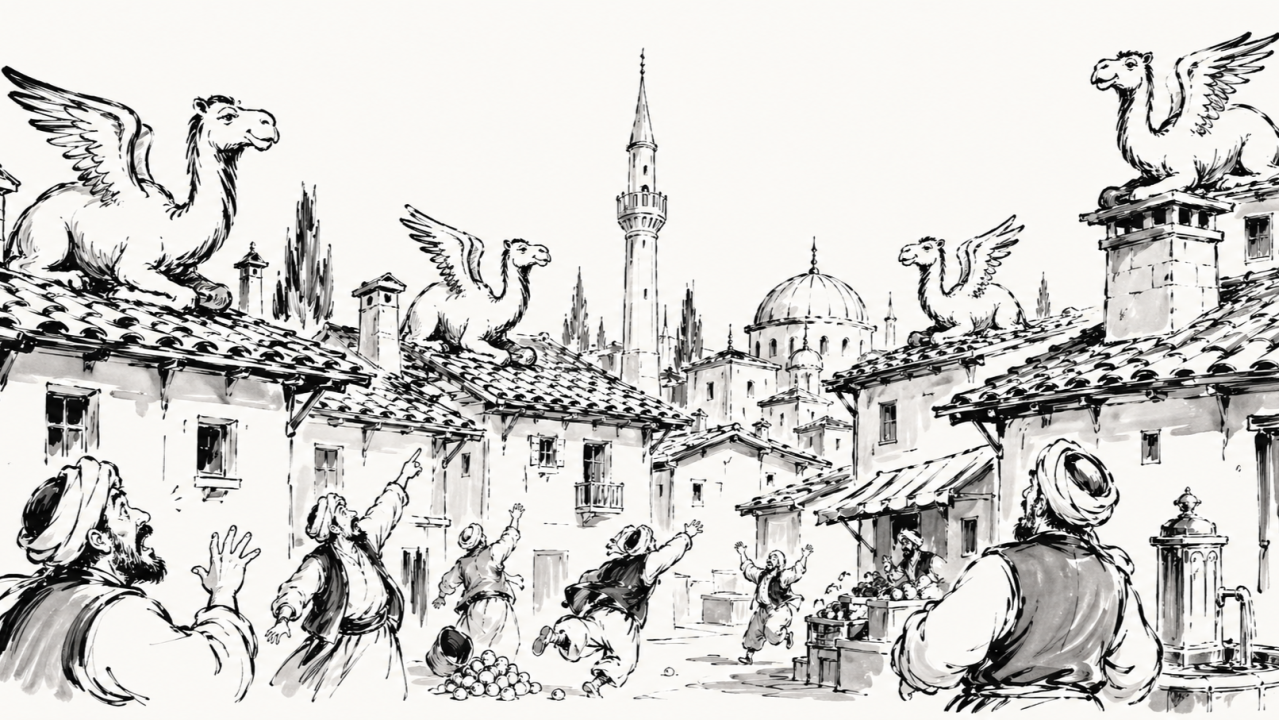
One of my favorite books is The Turkish Jester; or, The Pleasantries of Cogia Nasr Eddin Efendi.
It is a collection of short, often absurd Nasreddin Hoca stories. I keep returning to it because the stories catch something uneasy and familiar about people: how we communicate, reason, explain, trust, misread, rationalize, and avoid responsibility.
As agentic AI becomes part of daily work and daily hobbies, not only software engineering but knowledge work more broadly, some of these stories keep coming back to me. Then again, I find them relevant suspiciously often, so this may be more of a personal defect than an insight.
I am mostly thinking here about agentic AI, not LLMs in the broadest possible sense. Of course the line is blurry, and some of the same problems exist in ordinary chat use. But they become more interesting, and more dangerous, once the tool can act.
The more capable the tools become, the more I find myself thinking about all the dull things around them.
That said, you should know that I am just using agentic AI as an excuse to share a few excerpts from The Turkish Jester. I really like this book, probably more than this article can justify.
Here are five old stories, and one modern one from Hacker News.
1. The candle in the dark
One day a man arriving, became the guest of the Cogia. It happened at night, some time after they had lain down, that the light went out. ‘O Cogia Efendi,’ said the guest, ‘the taper is gone out. But there is a taper on your right side; pray bring it, and let us light it.’ ‘Surely you must be a fool,’ said the Cogia. ‘How should I know my right side in the dark?’
Source: The Turkish Jester, Project Gutenberg
Maybe I am forcing the connection, but when I reread this, I thought about how we give instructions to AI tools. The guest’s request is not nonsense. It just assumes orientation that Hoca does not have.
I suspect I do this all the time with AI. I write things like “check this”, “make it better”, “prepare this properly”, “use the usual structure”, or “this is crap”, and I implicitly assume that the tool shares my context. Usually it does not. A lot of the real meaning is somewhere else, often in my own head. Then I get annoyed, which is convenient.
2. The cock and the castle
One day the Cogia put some fowls into a cage and set out for the castle of Siouri. As he was going along he said to himself, ‘These poor wretches are here imprisoned: I think I may as well give them a little liberty.’ So he let them all out, and all the hens ran off in one direction or another. The Cogia taking a stick in his hand, placed himself before the cock, pushing him and driving him, saying, ‘O you who in the middle of the night knowest when it is morning, how is it that in broad day thou knowest not the way to the castle?’
Source: The Turkish Jester, Project Gutenberg
This one is probably the most unfair to the rooster, which is why I like it. Poor rooster. It knows morning, not geography.
A tool writes well, so maybe it understands the topic.
It finds a bug, so maybe it understands the system.
It produces a confident answer, so maybe the answer is grounded.
Maybe. Sometimes. Not necessarily.
This is an easy trap with agentic tools: visible competence in one dimension makes it tempting to infer competence in another. And often the missing part is the one I only notice later.
3. The water of the water of the hare
One day a man coming from the country brought the Cogia a hare. The Cogia, with much politeness and civility, gave him some broth to eat. At the end of a week he came again; but the Cogia appearing to have forgot him, said, ‘Who may you be?’ ‘I am the person who brought the hare,’ said the man; whereupon the Cogia again entertained him. After some days a number of men made their appearance and wanted to be entertained. ‘Who may you be?’ said the Cogia. ‘We are the neighbours of the man who brought you the hare,’ said they. A few days after a whole troop of men arriving, the Cogia asked them who they were? ‘We are the neighbours of the neighbours of the man who brought the hare,’ said they. ‘You are quite welcome,’ said the Cogia, and placed before them a large jar of pure water; on seeing which they said, ‘What is this?’ ‘The water of the water of the hare is what it is,’ said the Cogia.
Source: The Turkish Jester, Project Gutenberg
I think this is how a lot of AI advice starts to feel after it has travelled far enough:
Someone tries a tool on a real task.
Someone else summarizes it.
Someone turns the summary into a rule.
Eventually, it becomes a “best practice”.
I do not think this means shared AI practices are useless. But the portable version often arrives without the part that made the original useful. I may just be drinking the water of the water of the hare and calling it a methodology.
4. The cauldron
One day the Cogia borrowed a cauldron of a brazier, and carrying it home, put a little saucepan into it, and then carrying it back, returned it to its owner. The owner seeing a little saucepan in the cauldron, said, ‘What is this?’ ‘Why,’ cried the Cogia, ‘the cauldron has borne a child’; whereupon the owner took possession of the saucepan. One day the Cogia asked again for the cauldron, and having obtained it, carried it home. The owner of the cauldron waited one day and even five days for his utensil, but no cauldron coming, he went to the house of the Cogia and knocked at the door. The Cogia coming to the door, said, ‘What do you want?’ ‘The cauldron,’ said the man. ‘Oh, set your heart at rest,’ said the Cogia, ‘the cauldron is dead.’ ‘O Cogia,’ said the man, ‘can a cauldron die?’ ‘Oh,’ said the Cogia, ‘as you believed it could bear a child, why should you not believe that it can die?’
Source: The Turkish Jester, Project Gutenberg
This one is uncomfortable because I recognise the pattern.
When an AI tool gives a good result, I am tempted to call it understanding. When it gives a bad result, I am tempted to blame the prompt, the context, or myself only in the most abstract way. Sometimes those excuses are true. But then the same standard should apply in the positive direction as well.
If a failure does not fully count because the surrounding context was poor, then maybe the success should not fully count either. It may have been lucky. It may have looked better than it was.
The cauldron story is a nice trap. If I believe the birth too easily, I should probably not act shocked by the death.
5. The stones in the pot
Cogia Nasr Eddin, at the time of the Holy Ramadan, thought to himself, ‘What must I do in order to hold the fast in conformity with the people? I must prepare an earthen pot, and every day put a stone into it, and when thirty days are completed I may hold my Beiram.’ So he commenced placing stones in the pot, one every day. Now it happened one day that a daughter of the Cogia cast a handful of stones into the pot, and a little time after some people asked the Cogia, ‘What day of the month is it to-day?’ Now it happened to be the twenty-fifth. The Cogia, however, said to them, ‘Have patience and I will see’; and going to his house and emptying the pot, perceived that there were a hundred and twenty stones in it. Says the Cogia to himself, ‘If I tell the people all this number they will call me a fool.’ So going to them he said, ‘This day is the forty-fifth day of the month.’ But, said they, ‘O Cogia, a month has in all but thirty days, so how can you say that to-day is the forty-fifth?’ ‘I spoke quite within bounds,’ said the Cogia. ‘If you were to see the account in the pot you would find that to-day is the hundred and twentieth.’
Source: The Turkish Jester, Project Gutenberg
I like this one because it is barely about AI at all.
One day, one stone. Fair enough. Then extra stones enter the pot. The process still runs. The counting still works. The answer is still produced. It is just no longer meaningful. A lot of AI work can look like that. The process can be clean while the inputs are already spoiled.
The agent may count the stones correctly. That does not mean the right stones were in the pot.
6. A modern sixth story
A modern version of the same theme appeared on Hacker News today as I post this: “An AI agent deleted our production database. The agent's confession is below.”
The Hacker News thread linked to a post on X.
The author's framing was very interesting. One comment put it more directly:
“An AI agent deleted our production database” should be “I deleted our production database using AI”. You can't blame AI any more than you can blame SSH.
Source: A Hacker News comment
It sounds harsh, but I agree. If an agent can touch production, delete things, or operate with broad credentials, that did not happen by magic.
It may be more comfortable to tell a story where the agent did something strange. But the older Hoca stories make me suspicious of that comfort.
Maybe the room was dark.
Maybe we expected the rooster to know the castle because it knew the morning.
Maybe we were drinking the water of the water of the hare.
Maybe we believed the cauldron when it gave birth.
Maybe the pot was already full of the wrong stones.